
ADIUVIS® Pinhole CVH MG glasses
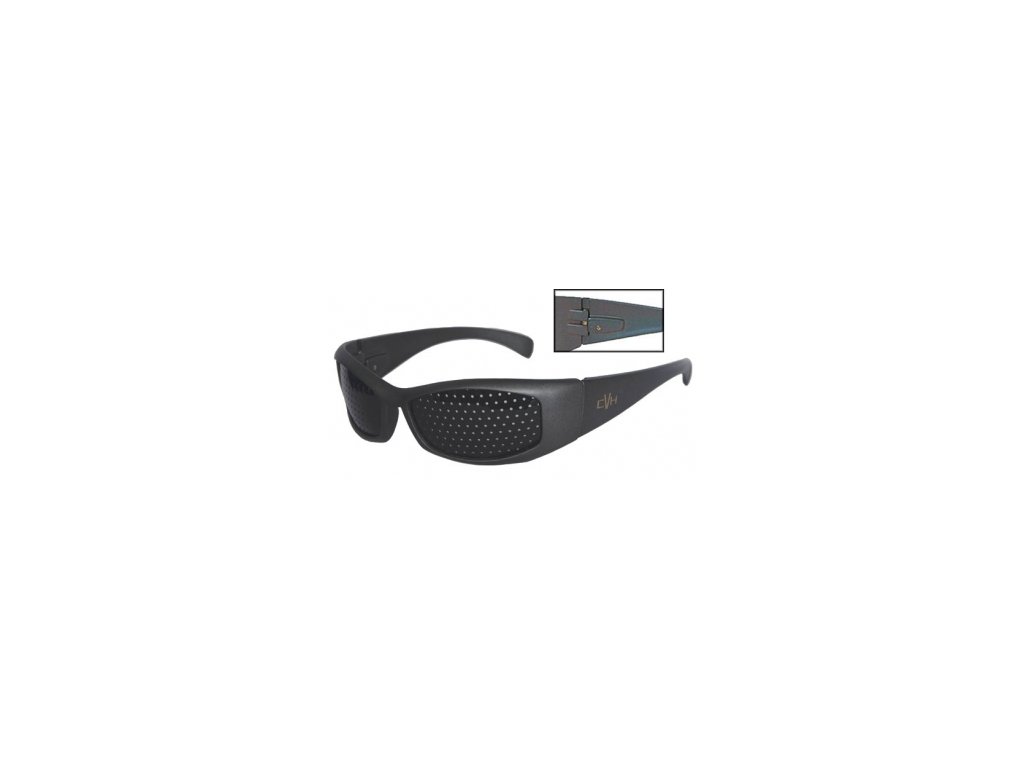
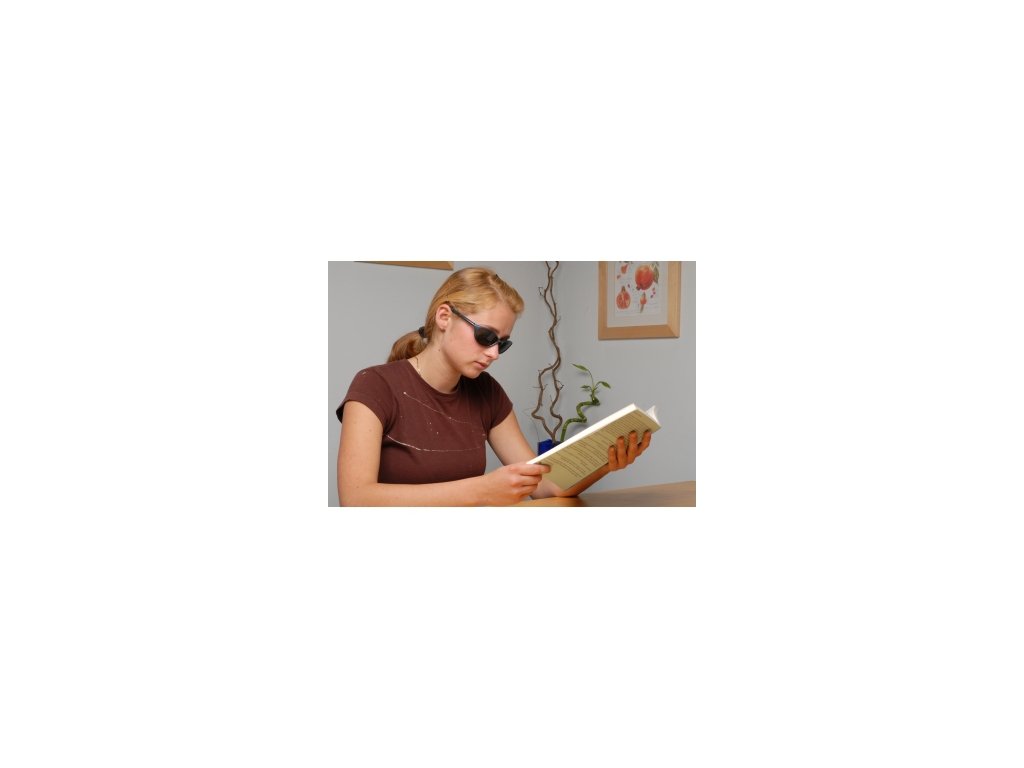




Piercing glasses are made of opaque plastic or metal with small conical holes. These are arranged so that the incoming rays of light are directed directly at the eye receptor cells in the macula of the retina.
Piercing glasses enable vision training thanks to a combination of three mechanisms:
They "pull" our eye muscles out of their stupor, forcing them to actively focus and seek the optimal position for observing individual objects.
They limit the amount of light rays hitting the retina. This provides the eye receptors with fewer stimuli, making it easier for the eye affected by an eye defect to focus (every photographer knows that narrowing the opening for light entering the camera means increasing the depth of field). Moreover, because the rays come mainly from the center of the field of vision and less from its edges, a minor change in the shape of the lens is required for their correct curvature. Thanks to this, even people who otherwise cannot do without prescription glasses can see clearly with perforated glasses. This helps their eyes to relearn their proper function.
They improve the brain's ability to evaluate the received image. Even though the eye provides only an incomplete image of the surroundings, the brain tends to complete the missing pieces of the "puzzle".
How to use perforated glasses?
Using the glasses is simple: just wear them regularly, preferably every day, during normal activities.
Initially, 5 minutes a day is enough. If your eye muscles are not used to working properly, you will feel eye fatigue even after such a short period of time - almost like when you visit the gym for the first time in years. Gradually increase their wearing time to at least 15, but preferably 40 or more minutes a day.
Use them as a replacement for prescription glasses, i.e. do not wear contact lenses under them. However, because they limit peripheral vision, they are not suitable for driving a car and other activities that require visual accuracy.
For farsightedness and astigmatism: If you see well at a distance but have trouble focusing on close objects, use perforated glasses especially for activities where you look mainly at close objects - for example, when reading, working with a computer, etc.
For myopia: Wear perforated glasses especially in situations where you need to focus at a distance - for example, when walking in nature.
For childhood myopia: Myopia often appears shortly after starting school. The child then has no problem reading or writing, but has great difficulty seeing on the blackboard. Here, perforated glasses can be very useful, and it is therefore advisable to try them before the doctor prescribes the appropriate diopters. The child sees the distant board through only one hole, so it is easier for him to focus on it and his vision is trained. This can contribute to the complete disappearance or significant improvement of the eye defect.
For combined defects: For example, if you are short-sighted and at a certain age you also start to suffer from presbyopia, or senile farsightedness, then doctors usually prescribe two glasses, or so-called bifocal or multifocal lenses, which are not completely perfect, however. Perforated glasses support correct and smooth focusing when looking at distance and up close, and therefore help you see objects at different distances clearly.
For eye fatigue: Especially when working on a computer for a long time, eye fatigue, burning eyes and feelings of dryness often occur. This can also cause stiffness and pain in the cervical spine, headaches, etc. Pinhole glasses can help you avoid all these problems. However, use them especially when working with text files. If you work with graphics programs, they can cause inaccuracies in the perception of colors, details, etc.
As sunglasses: When wearing pinhole glasses, less light falls on our eyes overall and therefore less UV radiation. Thanks to this, they can contribute to light protection when in the sun (the same principle is used by many indigenous peoples), without distorting the solar spectrum, as is the case with regular sunglasses.
Why ADIUVIS® Pinhole CVH pinhole glasses?
The conical holes of ADIUVIS® Pinhole CVH glasses have a diameter of 1.1 mm x 2.5 mm. This size is optimal for both nearsighted and farsighted people. Larger diameter holes (1.2 to 1.5 mm) do not work properly for farsighted users.
When will the results come?
Punched glasses are primarily designed to help you stop the development of eye defects and diseases and prevent them from worsening. However, with regular exercise, vision often improves by up to several diopters.
Each person reacts differently. Some people report significant improvement after just a week of use, while others need at least three weeks to notice the first results. To achieve more significant progress, we recommend at least three months of daily use.
For greater effectiveness of perforated glasses, however, it is advisable to combine their wearing with other methods that can contribute to improving vision - with performing eye exercises according to the Bates method, using nutritional supplements or working on the relevant aspects of the psyche.
Additional parameters
| Category: | Topics |
|---|---|
| EAN: | 8595229204879 |
Be the first who will post an article to this item!
Be the first who will post an article to this item!